


From House Music to Atmos, Vince Lawrence Keeps Reinventing Sound
Updated: 5 hours ago
By Julie Simmons | Music Journalist
From 1st & 15th Studios on Chicago’s west side, Vince Lawrence tells his story. Speaking with an extremely measured cadence, he sets a slow tempo for a mesmerizing three-hour discussion. The meticulously constructed, insulated walls of the studios absorb ambient noise, leaving only vocal clarity and intonations. His black-rimmed glasses are smudgy, but it doesn’t seem to matter because he’s always looking beyond what’s directly in front of him.

Lawrence leans back and settles into the memory of when he helped define “Chicago’s only truly indigenous Black folk music”: House Music. The scene opens in the late 1970s. Big studios dominated the airwaves with glossy hits like Stevie Wonder’s “Sir Duke,” Chicago’s “If You Leave Me Now,” and Earth, Wind & Fire’s “September.” As with each of those examples, many top 40 singles relied on lush strings and sharp horn sections which sounded full but also unmistakably expensive.
Lawrence spent much of his childhood in a recording studio with his father, who was friends with Curtom Records’ founder, Eddie Thomas. Raised in what some would call “the deepest South Side neighborhood,” Lawrence longed to own a recording studio so he could make music, but the cost of such an elaborate setup made the dream feel out of reach. These days Lawrence feels he has a chance to be the person he needed when he was starting out.
He reflects, “I’m from Roseland. The lore of Roseland is ‘The Wild Hundreds’ [100th Street to 147th Street]. Based on those stories and even statistically, I’m not supposed to even be here right now. I’m supposed to be dead, on drugs or in jail. When I started making my own music, I was only 15 years old. I wasn’t a skilled musician, and I couldn’t afford to work with real musicians like the guys I grew up watching.”
While R&B, funk, soul and pop were on the airwaves, discoteques were bringing people together.
Though it might not have been evident to all Americans at the time, disco originated in the Black and gay communities; its sound required a lot of musicians who could play brass and stringed instruments. While session musicians benefitted from disco and the sound went mainstream thanks to blockbuster movies like Saturday Night Fever, rock deejays and music executives across the country saw the decline in rock music and rise of disco as a financial if not also a cultural threat. Among some outside of the scene, “Disco became code for the ‘n-word,’ Lawrence recalls.
And so, the “disco is dead” backlash began.
Documented as “Disco Demolition Night,” Chicago made national news when a rock deejay encouraged thousands of fans to bring their disco records to Comiskey Park, home of the Chicago White Sox baseball team, to be destroyed in exchange for a ticket to a doubleheader game. Lawrence happened to be working at Comiskey that night. As a firsthand witness, he attests there weren’t any people of color attending the event and multiple forms of Black art were being destroyed, not just disco music but also R&B, jazz music, etc. The night ended with a destructive riot inside the stadium.
“Even today, the forfeited game dominates discussion more than public lynching of popular Black culture. The team never apologized,” he reports soberly.

Synchronistically, the democratization of music innovation came along right around the time of the disco backlash.
Lawrence continues, “I couldn’t afford musicians, but I could get this little machine. I couldn’t afford a studio, but I had a boom box with a cassette deck. Everything was so portable. So, I’m gonna bring my synth to the party this weekend and I’m going to start playing along to the records.”
After being the victim of a hate crime, Lawrence says the money meant to buy his silence bought his very first synthesizer. And he would use that synth to pioneer House Music. The birth of house music holds historical significance because while jazz and blues “grew up” in Chicago, both of those styles originated from America’s Deep South.
“House Music is ours [Chicago’s],” he boasts proudly. “We wanted to make music that moved specific people at our teen parties. The great thing about those teen parties is that they’re honest. We learned exactly which parts of which records they liked. If people liked the music, then they would dance. It was a pretty simple experiment. The relationship between deejays and people is a sacred one. It’s like Church.”

By the time Lawrence was old enough to legally drink, he’d achieved Malcolm Gladwell’s 10,000-hour goal, unofficially attaining world-class expertise by creating Chicago's first house music band, mastering tech by strapping a synth around his neck and observing which kind of samples and beats made people move.
He visualizes, “Almost like I’d notice that people like this kick drum more when it’s raining. Some music’s better outside than inside. Sometimes, the best place for music is in small, enclosed spaces with low ceilings. Underground music by example feels great when the ceiling’s low.”
The Chicago house music scene went international, and in doing so, its popularity called for an industry-wide economy of sound that demanded efficiency. Studios no longer hired large brass and string ensembles. Fully aware that complexity had been replaced by simplicity, Lawrence correlates, “We knew that disco is to house music as orange juice is to Tang. It’s just the parts and the flavor without necessarily including more substance. Where complicated jazz rhythms made up much of R&B at the time, we reduced it to “1 - 2 – 3 - 4. BOOM, BOOM, BOOM, BOOM,” aka "four on the floor."
Sensing a massive incoming wave, Lawrence co-founded the influential house music label, Trax Records. Within a few years, licensing laws were enacted to protect original recording artists from sampling technology. Ironically, Lawrence watched artists in his circle spending hundreds of thousands of dollars on licensing music that was originally recorded with a room full of brass and string players. Most notably, Beyoncé and Jay-Z’s “Crazy in Love” used the horns from “Are You My Woman? (Tell Me So)” by the Chicago-based vocal group The Chi-Lites.
Enter the Chicago native who's widely considered to be one of the greatest horn and string composers of all time.
Tom Washington (aka Tom Tom 84) wrote and arranged the horns for songs like “September” (Earth, Wind & Fire), “Sussudio” (Phil Collins), “Easy Lover” (Philip Bailey and Phil Collins), and “Can You Feel It” (The Jacksons). He also served as a mentor to Lawrence, and people like him in his youth. Giving Washington access to these new studios has created a full circle moment.
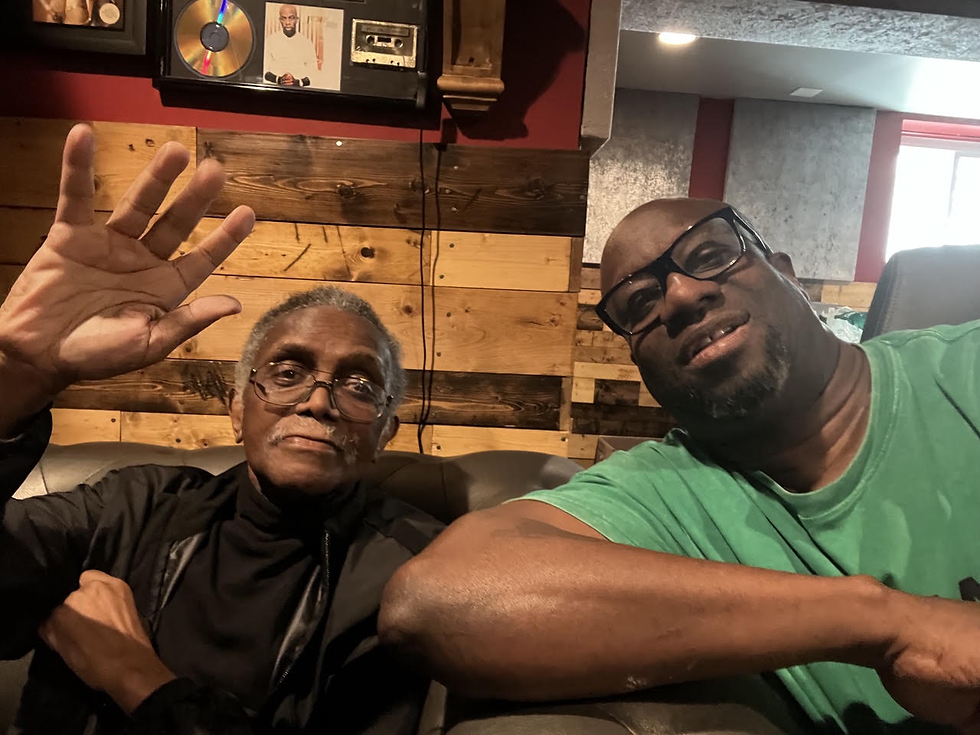
Lawrence uses his gaze to direct my attention to an expanded section of the studio and explains, “We wanted to build spaces for people like Tom. We wanted to pay homage to his work and give him a place where he can work and create as long as he can.”
When partnering with Charles “Chill” Patton, who manages rap god Lupe Fiasco and founded the groundbreaking 1st and 15th Record Label, they agreed that they should extend original floor plans so they could accommodate Washington’s live string and horn-ladened orchestras along with its massive Augspurger Atmos system. Working together, Lawrence and Patton have the tools and staff for songs, movie scores, video games, live events, commercials and more.
Just last year, Lawrence served as executive music producer and sound mixer for an Allstate commercial that recreated reckless 1970s car chases. For that spot, Washington invited 20 musicians to resurrect the slick vibe. For Lawrence and Washington, it was a circular moment, but it didn’t close a loop. Rather than returning to the past, Lawrence is interested in helping others create new experiences. With money in his pockets and a full staff, he passionately presents Slang Music’s latest addition: the 7.3.4 Dolby Atmos.
As if imparting a secret, his gaze shifts left and right before narrating, “There’s an Atmos-based nightclub in New York. We’re having conversations about the implications of presenting Dolby Atmos in live settings like clubs and concerts.”
For those unfamiliar, Atmos is the next generation of surround sound which uses 14 speakers. In addition to speakers that are positioned in front, behind and to the sides of the listener, Atmos directs sound from above and uses all 14 speakers to move around the observer. Most people have experienced Atmos surround sound in movie theatres. The latest Apple products and VR equipment also use its binaural technology. Soon, he predicts that the democratization of innovation will grace mass populations once again.
“Once you experience [Atmos]," he begins his pitch, "you’ll realize that stereo sounds 'flat' just like the black and white television seems very flat compared to color because you don’t get the depth. At one point we were all listening to audio in mono. But when that sound went up from the speaker and hit the windshield and bounced off and spread around the car – it was miraculous. Then Stereo allowed us to hear trumpets coming from here and there. I think within five years, Atmos will be present in everyone’s Toyota Corolla and artists will find new ways to play with that and other toys like it.”
To demonstrate his point, Lawrence asks me to stand in front of a tower of 18” sub woofers, 15” mid-range drivers and a super tweeter with beryllium; an alkaline metal that’s considered the holy grail material for speakers due to its low weight, stiffness and ability to dampen sound. He invites me to put on my favorite song. I choose “Soul Flower” by The Brand New Heavies and The Pharcyde. Instantly, the room is filled with joy. Lawrence smiles and nods to the beat as he scrolls for the next song. Stevie Wonder. Songs in the Key of Life. “Love’s In Need of Love Today.” Again, the room overwhelms me with soulfulness, I begin to move, and I begin to feel like I’m taking the “Eyes Test” where I’m given faces of people and I have to determine their emotional state.
Then he puts on Michael Jackson’s “Human Nature.”
I’ve heard this song hundreds of times since childhood but standing in front of the Augspurger system, it’s as if stagnant particles that got caught on tapes were wiped away, leaving a clear path between breath and microphone. Until this moment, I’ve never experienced such clarity in a song. Just as the Hubble Telescope has the depth and clarity to observe the universe in its infancy, this studio’s equipment and precise studio configurations built by Kevin “Karp” Rodgers from Karp Designs sounds like you’re eavesdropping on the original recording session and stepping into Jackson’s heart at the time of the recording.
Michael starts to sing.
“Wait, why am I crying?” I look to Vince for an answer as I observe my own autonomous reaction.
“It happens all the time,” he nods and smiles knowingly.
When a song you’ve heard so many times makes you cry and you have nothing else to compare this moment to, a new memory is formed, and time slows down. There are technical reasons why I responded to the music’s clarity which include those speakers, the beryllium, and a ceiling with 77 hidden swinging baffles that convert sound energy into heat. And then there’s an emotional explanation; a singer’s sadness finally heard.

When asked if Lawrence feels technology can be pushed to the point of being biological, he thinks that it cannot. And the reason for that is that he believes humans’ tastes and influences aren’t predictive, especially for people who’ve curated their tastes based on not just knowledge but experiences. As astrophysicist Neil DeGrasse Tyson succinctly stated, “A.I. knows everything, yet understands nothing.”
At 62 years old, Lawrence has been awarded RIAA Gold and Platinum records, a Lifetime Achievement Award from The City Of Chicago, a Webby, and an Association of National Advertisers Multicultural Excellence Award, just to name a few. It’s hard to imagine that Lawrence can conceive of doing anything more. I pointed out that regardless of whether people recognize his name, he’s managed to maintain a global influence since he was a teenager. Lawrence and his team get to work with some of the most creative minds in music.
I ask while gently swiveling in a soft leather studio chair, “Does that global presence even feel real to you and if so, how do you find inspiration to do more?”
Lawrence intentionally pauses for effect before sharing, “I met Quincy Jones - who’s from Chicago [Bronzeville neighborhood] - at the MTV Video Music Awards [2005]. We talked about growing up in Chicago and my dad’s clique. I said, ‘Quincy, now that you’ve done everything that you could possibly do in music – you produced the all-time, best-selling record, [Thriller], how do you keep going? What’s your motivation?’ He said, ‘You know, it would be different if I didn’t recognize the one true obligation that all artists have. You never know which song you wrote will inspire the guy who comes up with the cure for cancer. The obligation is to die empty.’” Your creative art has to get out there in the world.
Lawrence reaches for his phone and swipes through a massive digital folder of images as he introduces his latest artistic pursuit: painting.
He pauses intentionally before recounting, “I once saw a $400,000 painting and I liked it. But I looked at my wife and said, ‘I bet I can do this. I bet I can make something that excites me as much as that painting.’ I didn’t need to spend [the value of] a house on that painting, but it served its purpose. If that painter hadn’t painted that exact painting, I would not have been inspired to think about painting as a form of creative expression. I’m a painter now (abstract expressionism) so it’s done its job.”

***
This article was originally published in Reel Chicago.
Do you like to talk about music in a way that's intellectual, civil and collaborative? Ask to join the Facebook Group, Music Makes You Think.
Comments