


CHILD ADVISORY: Mom’s Explicit Music
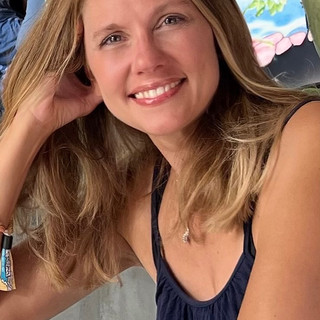
By Julie Simmons | Music Journalist
When my daughter, Lyric, was 11 years old, she testified to another grown up, "My mom listens to music with swear words. Even the F-word!”
Sensing immediate judgment, Lyric proceeded to backtrack and articulated my philosophy that "it's okay to swear in songs, but not around kids or old people."
Clearly, I had failed to follow my own rules. The grown up gave me a lopsided grin and looked over at some kids playing in woodchips to ground herself again.
My daughter spoke the truth. I do listen to what used to be labeled on CDs as “Parental Advisory: Explicit Content.” Once forbidden, now I’m hitting download with the privilege of a click when I’m by myself in the car. But apparently, Lyric and her brother, Fletcher, have a way of hearing everything, including the swear words.

I can appreciate my kids’ confusion.
It wasn’t long ago that we were falling asleep to Rockabye Baby! Lullaby Renditions of Radiohead and watching Biz Markie beatbox on Yo Gabba Gabba. But my music predates their existence.
I’ve been a music journalist since before my kids were born. So, there was always a strong probability that their little ears would be exposed to toxic phrases like secondhand smoke. But, in reality, they were sonically shielded for most of their early years. That is until I was forced to confront my past. And when I did, my playlists became noticeably harder to contain.
After school drop-off, I roll up the driver’s side window of my Toyota Hylander. I wait for the glass to groan between the tight embrace of the rubber and the metal frame. Then I take a hit of my music. I turn up the volume so the vibrations from the car speakers sync with the vibrations in my body. Resonating with my current frequencies are Haley Bonar, Against Me!, Phantogram, The Pharcyde, K Flay, Anderson .Paak, Glass Animals and A Tribe Called Quest (Pfife’s there’s too). One song gets me worked up while another helps me come down. I’m sorry I’m diluting each artist’s image by playing their songs from a Highlander.
They don’t seem to mind.
Once a month I go to a concert, usually by myself. Sometimes I think that the younger, agitated crowd expects me to hand over credentials like the way most Americans want to see a presidential candidate’s tax returns.
They don’t ask.
The music community’s very accepting. Maybe it’s because hardcore music is about people toiling with their repressed passions. Music has always been and continues to be my safe place for expressing passion and anger.
It’s not that I’m unassertive. I can be, especially when it comes to parenting. I can count to three before I warn my kids that I’m about to get mad. My problem is that I tend to let most things roll off me like water off the back of an oily-feathered duck. While this might seem very Zen, it’s more accurately an indication that I’m a serial forgiver. I need to flirt with a singer's rage, so I don’t come off in real life as naïve and inexperienced. And I’ll do it by listening to punk and hip-hop on repeat. I don't sing slurs, but I sing curse words. That's me putting on my armor. As I do, my thoughts go back to the kids.
I wondered why Lyric exposed me to that parent about my music.
Then I asked myself, Should I bring the music out of my backrooms? Or did I just need to explain what was going on in there?
I felt like my daughter’s attempt to expose me (to a seemingly more responsible adult) was possibly a cry for clarity. So, I took her aside and let her to get curious about my music.
She’s eleven. She can handle it.
“What do you want to hear?” I asked, as if I was offering her the Crown Jewels.
Together, we employed A Tribe Called Quest’s “We the People” as a learning tool for understanding the current social and political tensions in America. And we used twenty one pilots songs, like “Migraine,” to talk about depression and anxiety. In the end, by letting my music out, I let my daughter in.

Daughter, Lyric, at age 11
During this same time, my son was still too young; only eight years old. I told him not to cuss because it’s awkward to hear a child struggle under the weight of an F-bomb. So, he continued to listen to non-explicit music. Yet in his highly segregated world of second grade, where boys are often “versing” girls, Fletcher was drawn to a particular artist on my playlist.
A few years ago, the lead singer and guitarist for the punk band, Against Me!, Laura Jane Grace, transitioned into becoming the female she always felt she had been. One day, while doing research for a story pitch, Fletcher peered over my shoulder as I watched a video of her. Laura was doing an impressive mash-up song using Michael McDonald and The Cure. I could tell he was trying to process what he was watching.
“Is that a boy or a girl?” Fletcher asked very seriously through jack-o-lantern teeth.
“She was born a boy but always felt like she was supposed to be a girl so now she’s a girl,” I explained casually.
“So, is she's like my uncles?”
“No, that’s different. That’s when boys find other boys cute and girls find other girls cute. Laura says she still thinks girls are cute, but she just feels like she should’ve been born a girl,” I say.
Fletcher stopped talking and just watched the video play out. Then he asked, “Why when she sings doesn’t she sound like a girl?”
Without wanting to explain the inner workings of hormone therapy, I quoted something Laura had said in repeated interviews I’d read and watched.
“It doesn’t work that way,” I answered bluntly.
My son has always been quite analytical and especially back then, a rule-follower. So, learning about Laura’s transition kinda blew his mind. So much so that he felt compelled to share it with others, which led to another one of those moments where what your kids say to other grown-ups catches you finding your own truth.
“My mom’s trying to interview a singer who used to be a boy but turned into a girl,” he told his friend’s parents.
l responded honestly, “Her music helped me get through one of the most difficult times in my life."
In my own way, I'm becoming more of who I am.

My kids attend relatively diverse schools. Music has made their world even richer by pointing out more similarities than differences. For now, I’ve given both of my children permission to use music to express how they feel, especially when those feelings might seem contrary to the image they’re putting out to the rest of the world.
Recently, Lyric confided in me that she sang a swear word in a song. I detected guilt in her voice, so I reminded her that it's okay to swear in songs.
“Ok,” she smiled more confidently but not yet ready to let me see her imperfect self. “I’ll sing the H-word from now on in my room.”
UPDATE (5.20.26): Both of my kids now openly sing explicit lyrics and, as my mother would say, "they have mouths like a truck driver," yet they are extremely kind-hearted, accepting individuals who use music as a healthy outlet.
***
This article was originally published in MUTHA magazine in May 2017
Do you like to talk about music in a way that's intellectual, civil and collaborative? Ask to join the Facebook Group, Music Makes You Think.

Comments